


Description
These flutes have acquired different names and forms in the Basque Country. Txilibitu, txilibito, frantxuleta, txiflo and silbo are some of the names we have seen. As for the materials and the number of holes, there are also variations here. They have been used as toys but also as musical instruments.
The txilibitu
The standard txilibitu (fife) usually has six or seven holes; it has a one-octave scale, although most reach an octave and a half.
They can be made of cane, wood (e.g. elder), plastic or metal.

A plastic txilibitu of the Hercule Paris brand, owned by Alberto Zuloaga from Areatza. (Photo: JMBA)
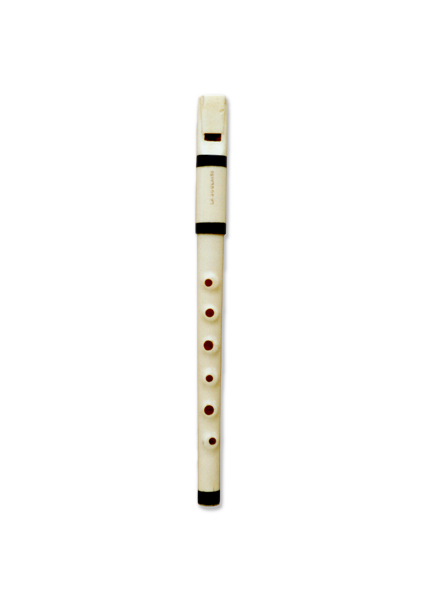
An old txilibito from Irun, made of plastic, Le Scolaire brand. (Photo: JMBA)
NAVARRE
José Mari Legarreta has told us about the presence of the txilibitu in Arano (Navarre) in the 1930s, and what it was used for1. They were made of elder wood collected from the village, and were usually 25 centimetres long and 2 cm wide. For the fingering they had seven holes, six on top and one underneath. They could play all kinds of pieces with these fifes, either in bars or village squares and streets. When there were no other instrumentalists (tabor/dulzaina player or accordionist) groups of young people played the txilibitu in the collection made at Carnival, and they played the pieces commonly heard in pasacalles (parade music) as well as those that people danced or sang to.

Reed Txilibitu. JMBA collection no. 810. (Photo: O. Zapirain - Soinuenea)
BISCAY
They also used txilibitus to play popular music in the 1930s in the area around Arratia. In this striking photo taken in 1930 we see a large group from Zeanuri next to the Tree of Gernika, consisting of a choir, dancers, alboka, txistus, atabala and tambourine players, as well as quite a few txilibiteros. This suggests that this flute was popular in the area.

Group from Zeanuri in Gernika, 1930. (Photo: Family of E. Sagarna)
In Areatza we met the txilibitero Alberto Zuloaga, who mainly played the repertoire of the albokaris and dultzaineros of Arratia.
We also have news of the txilibitu in Orduña. Jose Mariano Barrenetxea (1984) compiled information on this musical instrument. The procession of the Holy Burial has been held in Orduña every Good Friday since the 19th century, in which two musicians take part: one playing a txilibitu (pífano) and the other the tabor (pp. 50-52).
The Orduña fife has six holes on the top side. It is made of wood that looks like bone and the mouthpiece is similar to that of the current txistu. Apparently, it was created by the sculptor from Bilbao Basterra in the 1920s, and the txistulari brothers Landaluze and Jaime Fernández de Aguirre also participated in its manufacture.
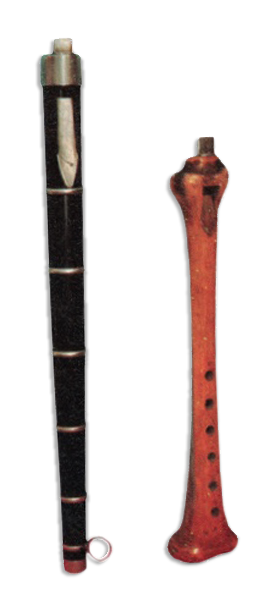
A txistu and a pífano (fife) from Orduña. (Source: Barrenetxea, 1984, p. 51)
The first flautist to play in that procession was Santos Mendia, who was succeeded by Ramón de la Fuente, José Rafael Madaria, Iñaki Cortazar, Carlos Ruiz and Aurelio de la Fuente. Epifanio Lejalde and José Antonio de la Fuente participated as tabor players.
The measurements of this flute are contained in the study by Barrenetxea (1984, p. 51). The piece played in the procession is short and does not have lyrics:

Score for the Good Friday procession in Orduña, written by Pedro Fernández de Aguirre. (Source: Barrenetxea, 1984, p. 50)
GIPUZKOA
As we can see in some photos from the 19th century, the txilibitu was often seen in popular festivities and celebrations in Tolosa. Juan de Dios y Iminarrieta and the tabor player Casimiro Saizar were key figures in festivities towards the end of the 19th century, as we can see from these photographs.
As the ethnographer Karmele Goñi pointed out in her study Etnografía en Zerain (1988), the txilibituek figured among the musical instruments that were played in festivities and popular pilgrimages (p. 654).

Txilibiteros and tabor players with a dance group in Izaskun in 1895. (Source: Tuduri, 1992, p. 215)
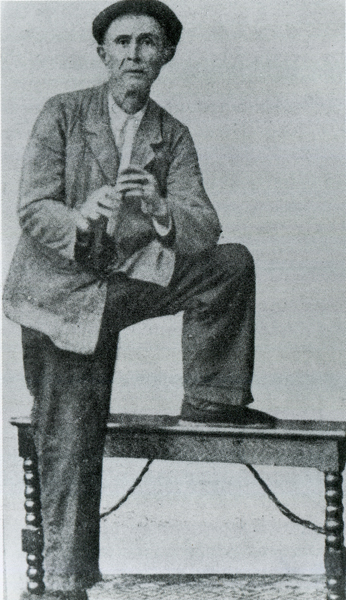
Juan de Dios, a txilibitero from Tolosa, in the 1890s. (Source: Tuduri, 1992, p. 221)
ÁLAVA
Flutes made of ash or elder have been used in the Treviño area. They were called txiflo or silbo, and had five or six holes in the front and one at the rear.
Juan Jose Lauzurica compiled information on this instrument (Lauzurica, 1986).
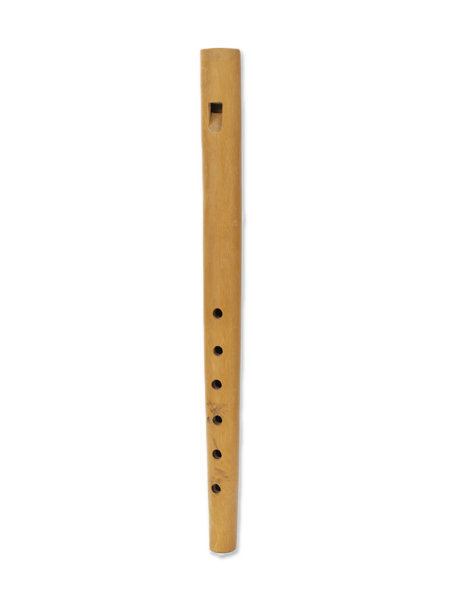
Txiflo made by J. M. López de Elorriaga. JMBA collection no. 831. ( Photo: O. Zapirain – Soinuenea)
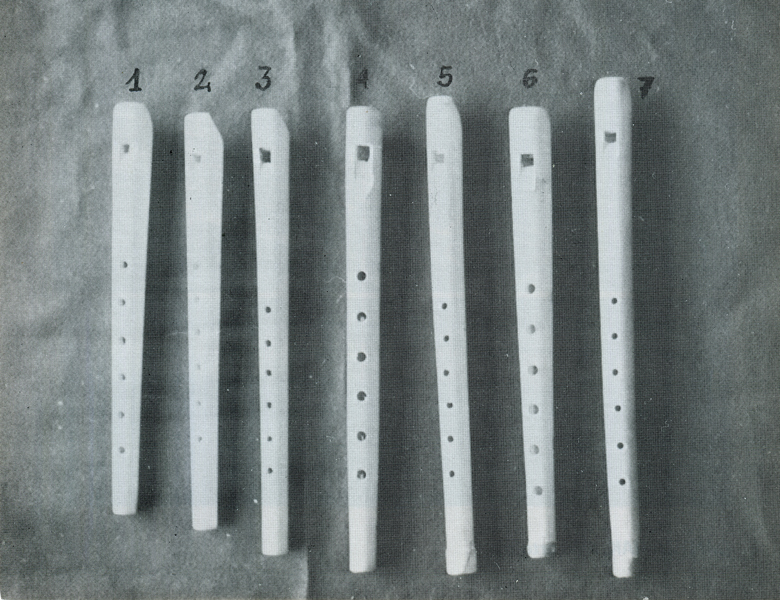
The three txilibitos on the left were made by Valentín Moraza and the others by José María López de Elorriaga, based on data compiled. (Source: Lauzurica, 1986, p. 6)
The txilibitus of the dulzaina players
Many dulzaina players have used this kind of flute, as it is similar to the dulzaina in terms of fingering, although it makes less noise and can be played without making a great effort.
In Gipuzkoa, Paulo Sagarna from Usurbil called it ‘txilibitu’, while those from Maltzeta (the area of Urola), the Lamarianos (from Antzuola) or the Montte brothers called it ‘frantxuleta’.
Braulio Elortza, a dulzaina and alboka player from the Ermasoro farmhouse in Segura, used the txilibitu to rehearse dulzaina pieces. He had a plastic txilibitu of the same brand and colour as the Hercule Paris of Alberto Zuloaga from Areatza.

The frantxuleta of the Montte brothers; they made another hole at the rear to play it like a dulzaina. JMBA collection no. 1021. (Photo: O. Zapirain – Soinuenea)

A dulzaina and reeds, a txilibitu and an alboka of Braulio Elortza, and another unfinished alboka. (Photo: JMBA)
The txilibitus in the alardes
In the Basque Country, the txilibitu has been used in alardes (commemorations of historic events, usually of a military nature) in many localities, in which large groups of txilibiteros are accompanied by a band of drummers. In the Bidasoa valley we can hear them in the festivity of San Marcial in Irun and the one in honour of the Virgin Mary of Guadaloupe in Hondarribia, and in the alarde held during the festivity of San Juan in Tolosa. In the Bidasoa area they use the term ‘txilibito’.
In the past they also used pífanos (fifes) or other small flutes (see the section on Transverse flutes), although since the mid-20th century the txilibitos are the only flutes heard in the alardes in Irun and Hondarribia. Since the end of the 20th century the most commonly used flutes are straight Irish metal flutes with six holes (whistle) and small recorders (making modifications to the holes).

Txilibiteros in the Alarde in Hondarribia. (Source: Feliu, 1983, p. 68)
Javier Bello Portu d the following scene:
In this procession (San Juan) there were bordondantzaris who danced the bordondantza in the evening when the Town Council attended Vespers and End-of-Day prayers and received the aurresku (ceremonial tribute dance) at the Prado de Igarondo. These dancers are preceded by a whistle and drum on the morning of San Juan. The whistle plays a typical fast tocata that are reproduced here in the examples of sheet music (example no. 3). It has something to do with certain processions in Zuberoa and Lower Navarre.2
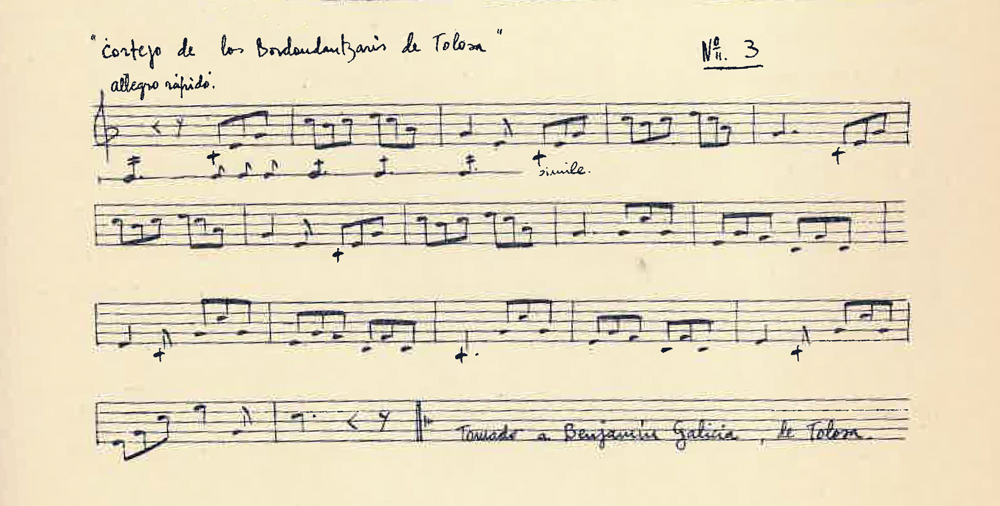
Score by Javier Bello Portu. (Source: Bello Portu, 1956, p. 177-204)
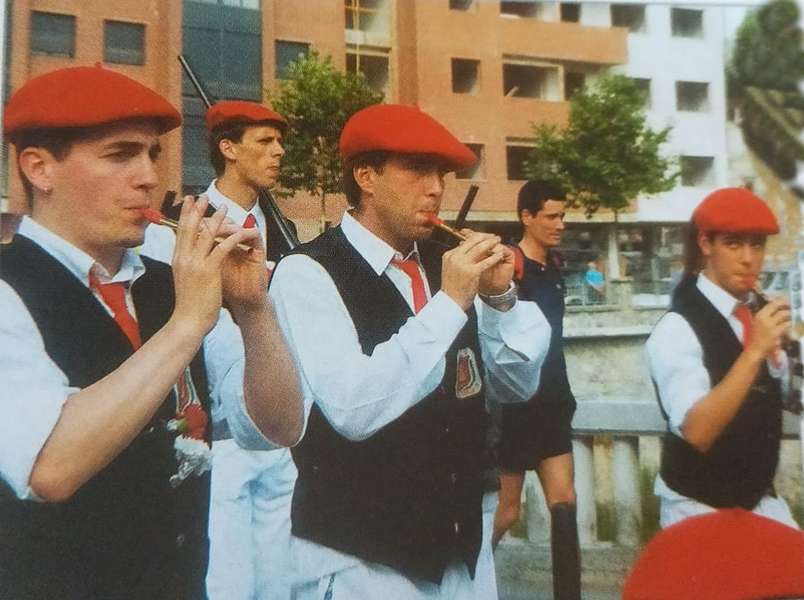
In this photo taken in Tolosa in the 1990s we can see txilibiteros like those who now participate in the Alarde de San Juan. (Source: Gorrotxategi, 2004, p. 141)
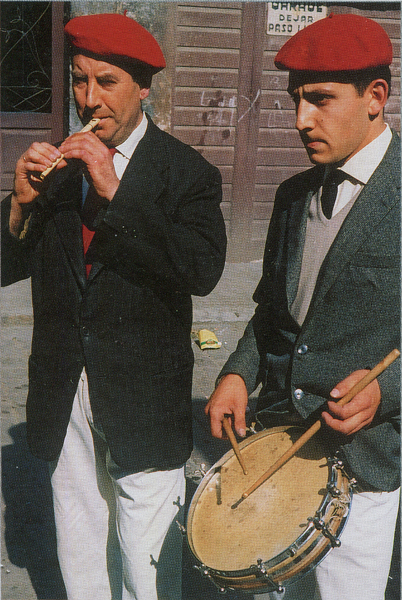
The txilibitero Román Tolosa in the 1970s. (Source: Gorrotxategi, 2004, p. 141)
ICONOGRAPHY
Álava
VALLEY OF ARANA
CHURCH IN SAN VICENTE DE ARANA
In this 16th century parish church in the small village San Vicente de Arana two children appear playing the flute at the two ends of the archivolt of the lower arch over the main altar. Although we do not know if the author did it intentionally, the flautist on the left is right-handed and the one on the right is left-handed. On this arch there are also two other musicians: a beast with a long tail playing a xirolarru and a monster that looks like a dog playing a horn.

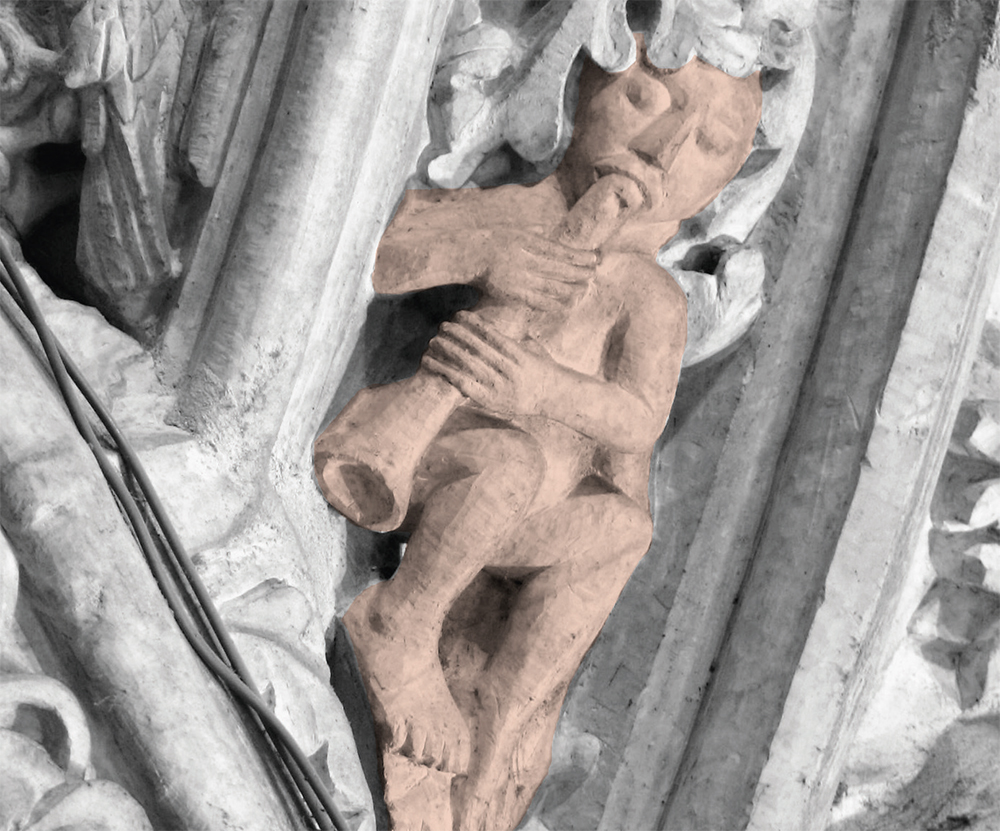
The two flautists in the parish church of San Vicente de Arana. (Photo: Aintzane Erkizia)
Biscay
LEKEITIO
BASILICA OF THE ASSUMPTION OF SANTA MARÍA IN LEKEITIO
The Church of the Assumption of Santa María, also known as the Basilica of Lekeitio, is a Late Gothic construction completed at the end of the 15th century.
Under the frieze of angels located below the main window on the façade of the Basilica we can see an angel playing a straight flute with mouthpiece other angels playing instruments.
We see a lyre, a rebec, a trumpet, a harp, a tabor, a zarrabete (hurdy-gurdy) a serpentón (bass wind instrument), a flute and what could be a tambourine or another zarrabete, and all the musicians are portrayed playing their instruments.


An angel appears playing the flute two angels playing other instruments on the façade of the Basilica of the Assumption of Santa Maria in Lekeitio. (Photo: JMBA)
ONDARROA
CHURCH OF SANTA MARÍA
The building work on the church of Santa María in Ondarroa started in the 15th century and was completed in the 16th. It is a building in the late Gothic style. At the top of the church there are some curious figures that go by the name of El cortejo (the procession - in Basque, Kortxeleko mamuak). They are sculptures that represent a mediaeval court and among them there are some instrumentalists, one of them playing a straight flute with mouthpiece.
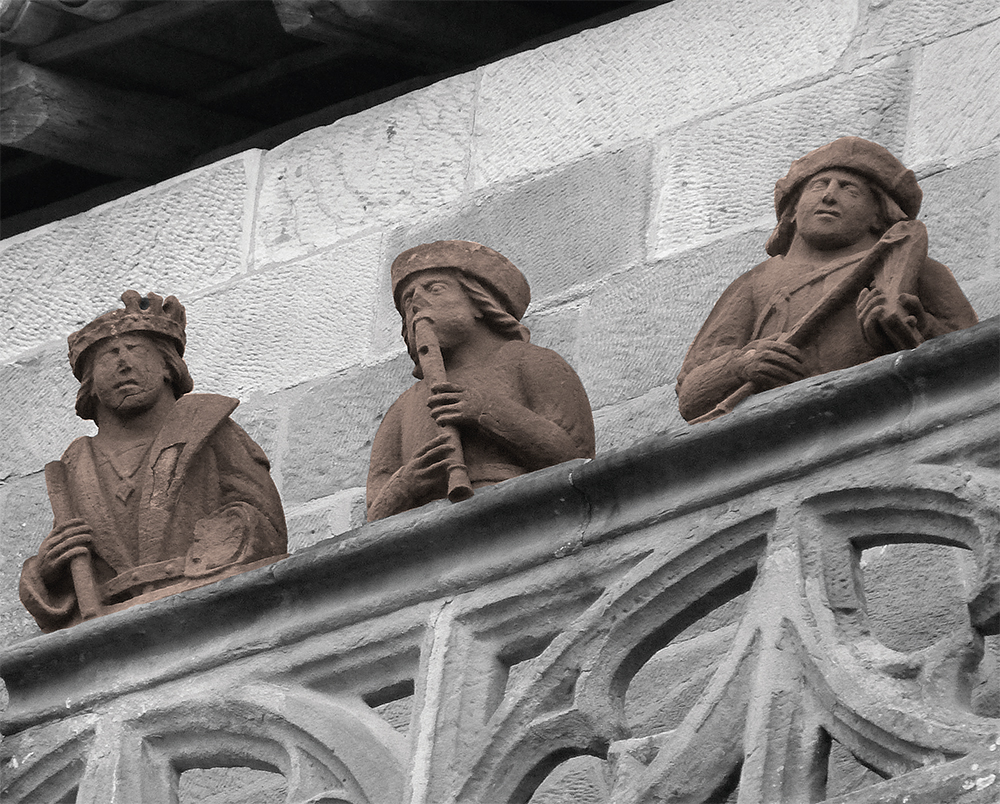
The flautist in the set of sculptures known as El cortejo on the church of Santa Maria in Ondarroa. Next to him, a rebec player. (Photo: JMBA)
Gipuzkoa
DEBA
CHURCH OF SANTA MARÍA
In the Renaissance Chapel of the second half of the 14th century in the church of Santa Maria in Deba —known as the Chapel of the Weaver— four musicians appear in two columns: at the top, one playing the lute and the other the lyre, and at the bottom left, one playing a kind of mandolin while another plays the flute on the column of the bottom right pilaster.

The flautist of the Chapel of the Weaver in the Church of Santa Maria in Deba. (Photo: JMBA)
Navarre
ALLO
PARISH CHURCH OF SANTA MARÍA
The parish church of Santa Maria is a 14th-century neoclassic church whose main altarpiece dates from the 16th century and was created by the sculptor Bernabé Imberto. We can see some scenes —among them the birth of Christ— in which a flautist appears at the lower part of the altarpiece. As can be seen, it is the same scene of the birth of Christ as the one in the parish church of Carcar, and is by the same author.


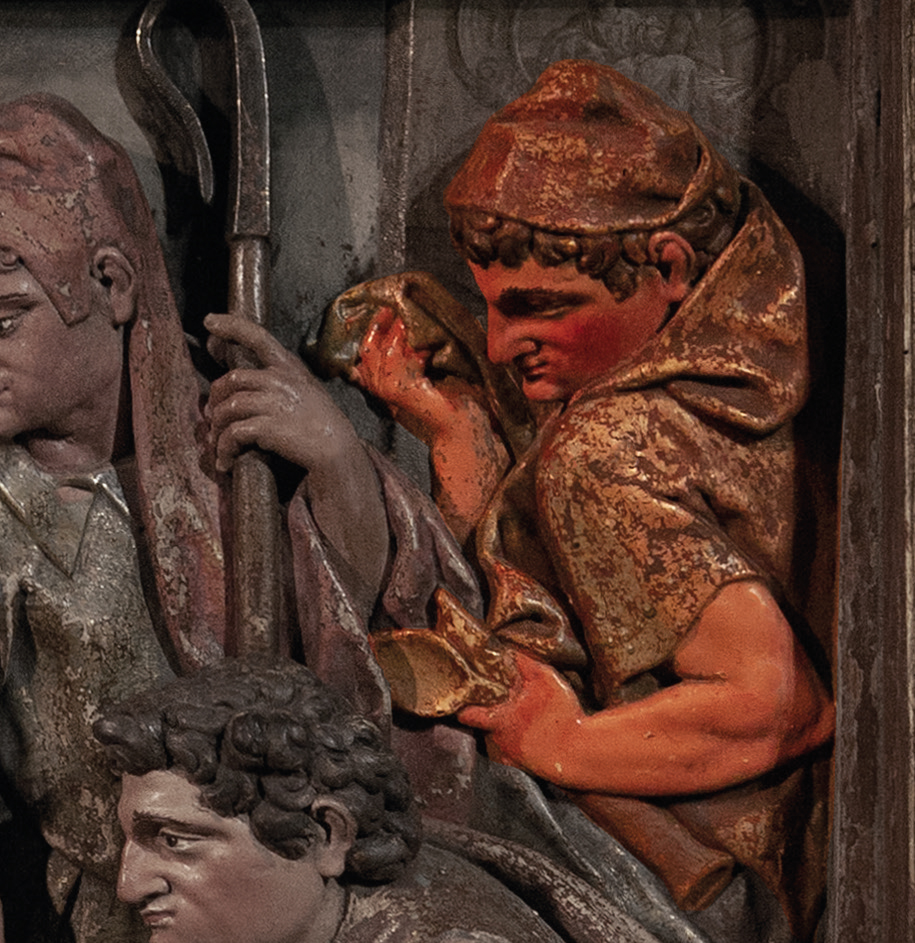
The flautist in the scene of the Birth of Christ on the main altarpiece of the parish church of Santa Maria in Allo. (Photo: J.I. Larraioz-JMBA)
CÁRCAR
CHURCH OF SAN MIGUEL
The church of San Miguel in Carcar was built in the raised Gothic–Renaissance style of the second half of the 16th century, and was extensively renovated in the 18th century.
At the base of the altarpiece of the Virgin Mary of the Rosary, the work of the sculptor from Estella Bernabe Imberto, a flautist can be seen in the scene of the birth of Christ. It is the same scene as on the main altarpiece of the parish church in Allo.

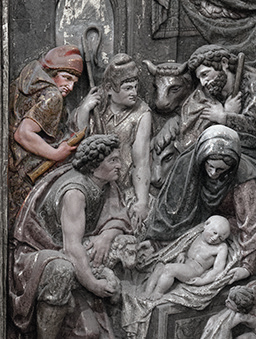
A flautist appears in the scene of the birth of Christ on the altarpiece of the Virgin Mary of the Rosary in the church of San Miguel. (Photo: J.I. Larraioz-JMBA)
LEIRE
MONASTERY OF LEIRE
The western front of the Monastery of San Salvador of Leire, called the Porta Speciosa (‘beautiful entrance’), dates from the 12th century. Some musicians appear on one of its archivolts, among them one playing what seems to be a straight flute with mouthpiece.


Flautist on the exterior archivolt of the Monastery of Leire. (Photo: JMBA)
ORISOAIN, VALDORBA
CHURCH OF SAN MARTÍN DE TOURS
The Church of San Martín de Tours in Orísoain was built towards the end of the 12th century. A flautist appears on one of the modillions at the rear, playing what seems to be a straight flute with mouthpiece.
The image of the flautist appears next to another smiling figure that could be a woman; this could have an erotic significance, quite common in Romanesque architecture.
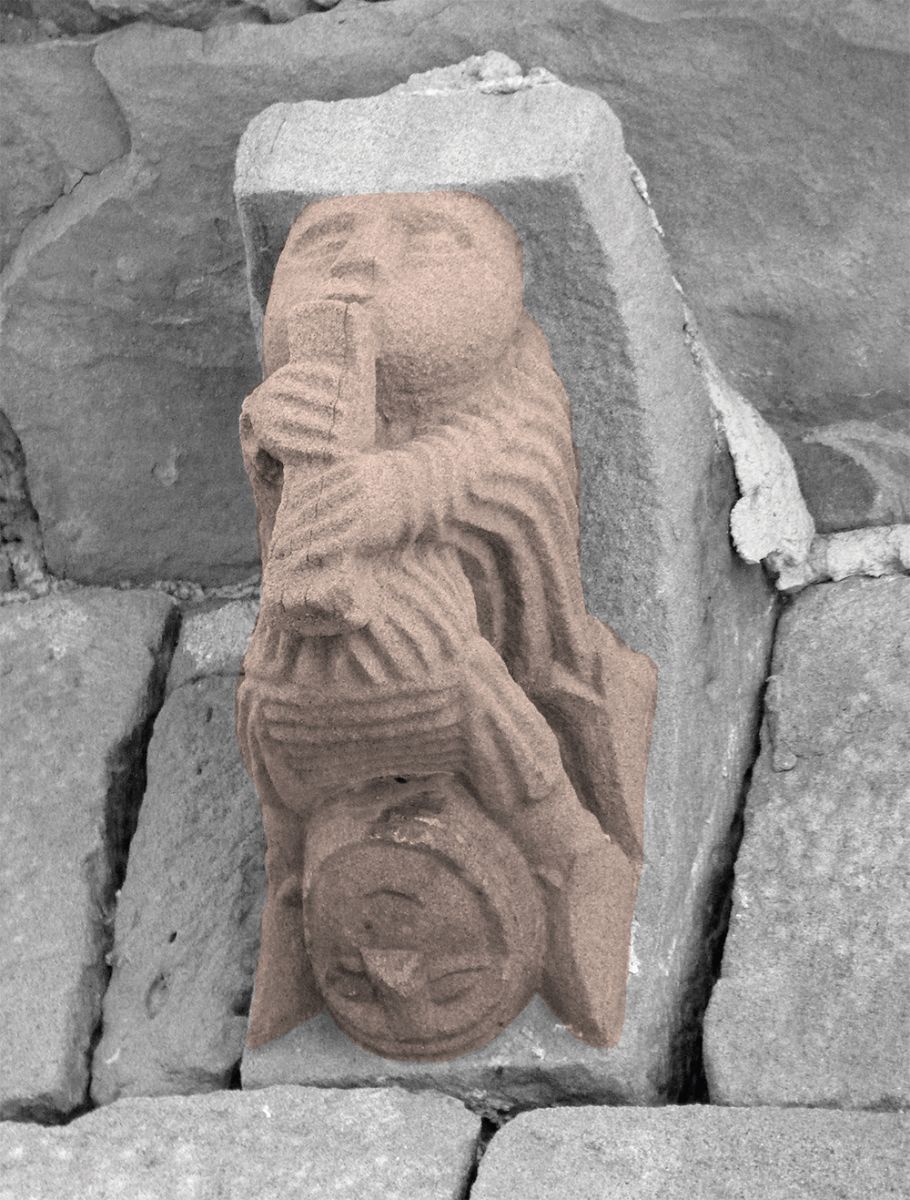
Flautist in the Church of San Martín de Tours. (Photo: JMBA)
REFERENCES
1 Interview by Juan Mari Beltran with Jose Mari Legarreta in Arano on 16 January 2000.
2 Bello Portu, 1956, p. 199.
A esta procesión (de San Juan), acuden los bordondantzaris que bailarán por la tarde la bordondantza, cuando vaya el Ayuntamiento a las Vísperas y Completas y al aurresku del Prado de Igarondo. Estos bordondantzaris van precedidos en esta mañana de San Juan por un pito y un tambor. El pito toca una típica y rápida tocata que reproduzco en la lámina de ejemplos musicales (ejemplo nº 3). Tiene algo que ver con algunos cortejos de Zuberoa y de Baja Navarra.
SOURCES
Bibliography
BARRENETXEA, J. M. (1984). Apuntes de Txistu. [autoedizioa]
BELLO PORTU, J. (1956). Música de la calle en Tolosa. In Hainbat Egile. Libro Homenaje Tolosa VII Centenario de la fundación de la Villa. 1256-1956. 177-204. Tolosako Udala.
BELTRAN ARGIÑENA, J. M. (1996). Soinutresnak euskal herri musikan. Orain.
BELTRAN ARGIÑENA, J. M. (1997). San Telmo Museoko soinu eta hots tresnak. Jentilbaratz 6. Eusko Ikaskuntza.
BELTRAN ARGIÑENA, J. M. (1998). San Telmo Museoko soinu eta hots tresnak. Lankidetzan bilduma. Eusko Ikaskuntza. [aurrekoaren berrargitalpena]
BELTRAN ARGIÑENA, J. M. (2004). Dultzaina Gipuzkoan. 1950. hamarkada arte. Herri Musika Bilduma, 1. HM Txokoa.
FELIU CORCUERA, A. (1987). Gure Herria. Tradiciones y costumbres del País Vasco. 4 liburuki. Kriseilu.
GORROTXATEGI PIKASARRI, J. M. (2004). Bordon-dantzari begirada-Una mirada a la Bordon-dantza. In Jimeno Jurio, J.M. Tolosa Bordon-dantzaren ikuspegitik. 125-171. Arantzadi Zientzia Elkartea.
GOÑI AUZMENDI, K. (1988). Etnografía de Zerain. Usos del grupo doméstico. In Erkoreka, A., Arregi, G. (koord.). Contribución al atlas etnográfico de Euskalerria: investigaciones en Bizkaia y Gipuzkoa 643-767. Eusko Ikaskuntza.
LAUZURICA, J. J. (1986). El chiflo. Dantzariak, 32, 5-9. Euskal Dantzarien Biltzarra.
RETEGUI, J. M. (2003). Tamborrada. Alarde de San Marcial de Irun. / Danborrada. Irungo San Martzialetako Alardea. Asociación Tamborrada del Alarde Tradicional de San Marcial de Irun.
TUDURI ESNAL, J. M. (1992). Argazkiak Tolosa – Fotografías. Tolosako Udala-Kutxa.
Discography
IRUNGO ALARDEA. (1996). San Martzial Eguna. Enixe Records / Enixe 02.
Filmography
BASTERRETXEA-LARRUQUERT. (1968). Ama lur / Tierra madre. Euskadiko Filmategia.
CARO BAROJA, Julio eta Pio. (1979). Gipuzkoa. Gipuzkoa-Donostia Kutxa.
LARRUKERT, Fernando. (1978). Euskal herri-musika. Euskadiko Filmategia.
Image gallery

Audio
ALARDE DE IRUN: START-UP, REVEILLE OF DRUMS AND MARCH OF SAN MARCIAL
The main protagonists of the soundtrack of the alardes (commemorations of military exploits) in Irun and Hondarribia (Gipuzkoa) are the drums and the txilibitos. We recorded these three important pieces from the repertoire of the Alarde de Irun on 5 August 2021 in Soinuenea, with the help of musicians from Irun.
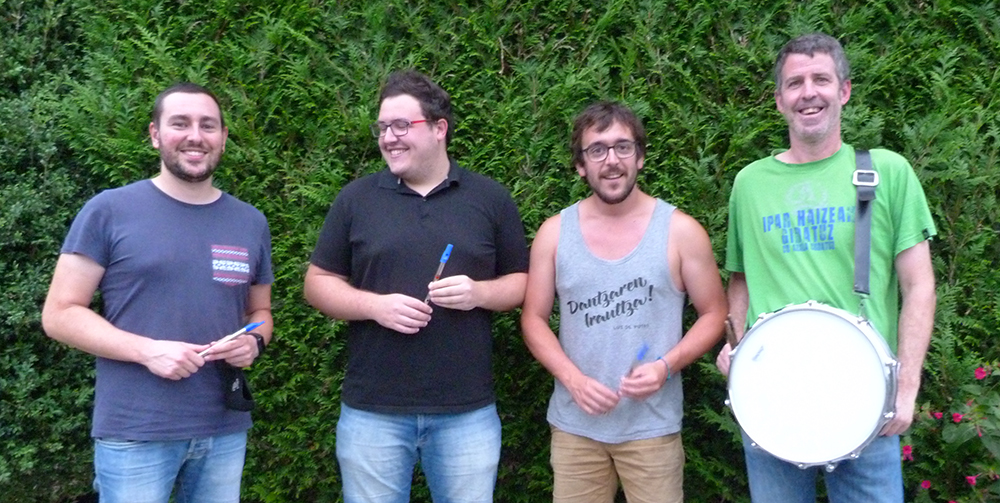
Txilibitos: Antton Babaze, Diego Martinez, Peio Irigoien. Drum: Lorentxo Ribera. (Photo: Soinuenea)
JOTA AND MARCH OF ARRATIA
As in many other places in the Basque Country, the txilibitu has also been very common in Arratia (Bizkaia) as a pseudo-musical instrument. In this record we have collected the jota and the march that the txilibitero Alberto Zuloaga performed in the session recorded by Manu Gojenola and Juan Mari Beltrán on 25 May 2000.

Alberto Zuloaga playing the txilibitu. Areatza, 25 May 2000. (Photo: JMBA)
JOTA DE LOS TOROS
This performance by Juan Mari Beltrán (chiflo) and Ander Barrenetxea (drum and tarrañuelas [two tablets held in the fingers and played like castanets]) was recorded in Soinuenea on 5 August 2021. The chiflo used is the work of José María López de Elorriaga from Vitoria-Gasteiz and is made from an elder branch. According to him, the old Alavese chiflo players he knew played pieces like this one. It is a flute that gives a special scale due to the position of the fingering holes.

Chiflo used in the recording (JMBA Collection no. 831) (Photo: Emovere - Soinuenea)
Txilibitoa. San Martzial Martxa. KD Enixe 02 (1996)
Full sheet
- Number:
- 102
- Classification:
- Aerophones -> Flutes -> Fipple flutes (two-handed) + kena
- Notes:
- STRAIGHT FLUTES WITH MOUTHPIECE


