Description
The eltzegor is a friction membranophone.
Description of the instrument
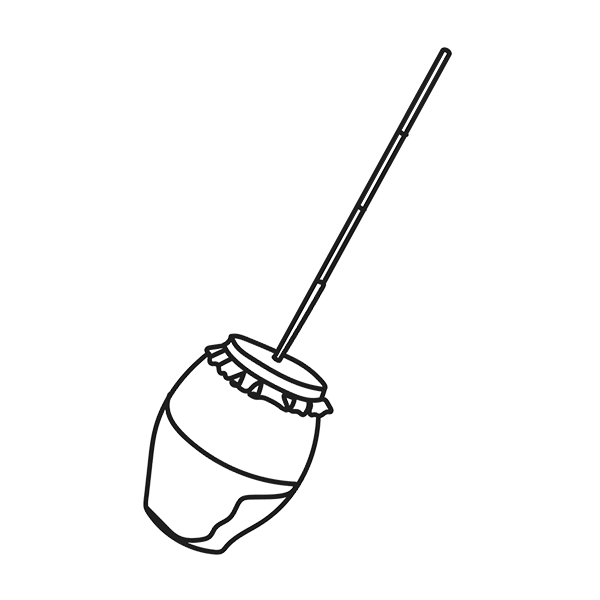
It is a pot of variable height (30-60 centimeters). Among those we know, except the one found in the town of Baigorri (Lower Navarra), all the others are made of clay. The bottom is removed from the pot and closed with a taut skin membrane. The rope is impregnated with pitch (resin) and passed through the center of the skin.
Way of playing
We learned to play with Leon Telleria. The instrument is held under the arm, its mouth facing forwards. The player punts one hand into the pot, and with two fingers (thumb and forefinger), rubs the string from inside to outside. This does not allow us to set a constant rhythm or sound, since the of the string limits us.
In the case of Baigorri, hanging the eltzegor from the neck and holding it against the body, the rope is taken by both ends and passed to one side and the other through the holes made in the middle of the skin. With this variant it is possible to give a constant and rhythmic sound.
If it is rubbed slowly it produces a low tone and if it is done quickly it becomes higher. Depending on how much the interpreter presses, the sound will be louder or weaker (Beltran, 1996).
History
This rubbed menbranophone sometimes appears under the s eltzabor, eltzaor, and eltzagor.
Although we have little documentation, many elderly people remember the incidents related to the instrument and the stories that were told. Some have known and used the instrument themselves. Its function in our environment has not been musical, but to create fuss, to scare or frighten.
Father Donostia (1952) wrote the following: “There is this friction drum in the Basque Country. It is called eltzabor, eltzagor. As in other places, this instrument consists of a round empty (clay) pot, with a taut skin on the upper edge. A spike is inserted into the center of it, which, rising and falling, produces a hoarse sound. Hence, in the Basque language it is said eltzagortu = tympanize, to make one deaf. Unlike other regions where this friction drum is played at Christmas, in the Basque Country it is used in charivaris. Eltzegor also means horn, which is played at night to drive off wild beasts and vermin” (p. 295).
Extensive information is offered in the book Soinutresnak euskal herri musikan (Beltrán, 1996). We do not know how spread this instrument was in the past, but the information we have received makes it clear that in recent times it has been played and used in Gipuzkoa, Navarra, Lapurdi and Baxe Nafarroa.
In the information collected here and there it is clear how special functions the eltzegor had or what it was used for: making noise and frightening or scaring away animals or people for different purposes.
In Baigorri, to report a fact that was socially frowned upon, for example, at a wedding an old man and a young woman, or before any other folly committed by someone from the place (even for not having given the young people the wine ed on the occasion of a wedding). They organized public events such as the "toberak", as a joke or mockery, but also in a serious, painful and reportable tone. These were carried out in the area where the accused lived.
To attend the "toberak", as a call, some characters called "Zirtzilak" (similar to the Buhamiak of the Suletin Masquerades) played the eltzegor around the place.
Peio Gurrutxarri from Baigorri told us that in other times, even in the mountains, they played to scare the mares.
In the Labortean town of Itsasu it was used to scare animals (horses and mares) and a local informant had heard that in Baigorri they played to intimidate and ward off wolves.
The people of the towns of the Navarrese valley of Larraun, around Mount Aralar, have kept herds, goats, mares and other animals free on pasture lands that were "communal." These animals, in the darkness and solitude of the night, tend to go down the mountain to the of the villages, and if they reach them, they cause great damage, eating and trampling what they find on their way. The owners of the , when they realized that the animals were wandering around, would take the eltzegor, approach them and begin to play to scare them away and send them back up the mountain. The animals, hearing that unpleasant, unbearable noise, would quickly move away along the mountain paths, scared, mad and blinded.
The locals say that in these blind and crazy escapes, many times, the animals crashed into a tree or whatever they found in front of them, or fell into a cave, where they lay wounded or dead. At times, some would also get lost.
It is clear that to people's ears it is an annoying and terrifying noise, but to the ears of animals it seems to be more than that. They seem to be in pain and they cannot bear the dissonances and frequencies the instrument produces. Father Donostia (1952) said: "Hence, in the Basque language they say eltzagortu = tympanize, make one deaf".
Seeing the use, function and influence that the eltzegor has had, it is not surprising that many people, including the authorities, took a position against it and that, therefore, it was prohibited everywhere and that players acted in secret, at night and hiding.
When the animals were lost, injured or died, the owners filed complaints and had many confrontations and fights with the owners of the , the alleged players of eltzegorra.
But the animals that roamed the forest came down and had to be fought against. It was not enough to scare them with sticks and shouting, because even if they moved a few meters away, for a while, when they were alone again, they would immediately return to those desired .
As the eltzegor was forbidden, ratchets with one, four or eight tongues were often used, although it seems that these did not fulfill their function correctly. Thus, in Baraibar we met another contraption that was composed of a kind of ratchet with several reeds, bells and other noises, all of which sounded at the same time (Beltran, 1996).
Leon Telleria Oiarbide, from Idiazabal, nickd "León Txiki", has been the one who has provided us with most of the information about the eltzegor. He was born in Segura (Gipuzkoa) on June 14, 1914.
He learned to make and play the instrument from his father, and according to what he told us, his uncle from the Lopategi farmhouse in Idiazabal also played. Leon taught us how this instrument is made and played.
"León Txiki" in his youth played in nearby towns and neighborhoods. He says they played in a gang and those who used to hang out with him were from Segura. This group, which had a reputation for being “troublemakers", played secretly and at night.
We will continue with the story of León Txiki (Beltran, 1996):
"We made the eltzegor and we tried it at home, in the "bakery "of one of the gang. When someone who was passing by heard the noise, he left scared and did not dare to return, saying that there was "news" on the block. I don't think it has yet been believed that we could make that sound.
Once, on the way home, we waited for a crew that was out for dinner. When we saw that they were coming, we hid next to the road and when they approached we played with this "pot". - Hey, what's there! Are they killing an ox or what? The others; - I won’t go! - In this darkness .... I have to take the stick, here is a barrier and we have to see what there is! No, no way! In a gang of ten or eleven young men who had been "volunteers" in the war in Africa, not a single one had the courage to get off the road. Jesus and I shut up, Hua hua ... Laughing softly.
One night, while they were celebrating the “Quintos” (peers’) farewell dinner, it occurred to them that they had to go to the hamlets to play the eltzegor. On the way they approached a donkey that was grazing. This was tied with a rope to a stake driven into the ground. "We blew the eltzegor and the donkey pricked up its ears, its tail up, puuurruuuut and ran off, pulling the stake out of the ground. Since then that donkey has not appeared.
Then, near Iturri-berri, we saw a man and started to play. He, scared, believing that he had a man in front of him lying on the ground, began to throw stones ... and we there beside him. It is said that the "cavalry" lose their senses and become disoriented, but the same thing happens to men”.
Then they approached a hamlet and secretly positioned themselves in front of the doorway and began to play. "When we started to play, the calf did maaa ... and I from outside, I replied in a similar style, and soon the cows and calves, all muuuuuuuu, muuuuuuu, scared; and when they started like that, the lights went on and soon they were in the stable and the man in the doorway, shotgun in hand. " That night they caused great damage, as the animals had been seriously injured trying to flee and pulling on the chains around their necks.
Such misdeeds made the surrounding people and animals shudder.
"Leon Txiki" only played two or three years. They left it out of fear and because they got bored; at first no one knew who they were, but suspicions were growing. He approved of the ban, as people were scared to death. According to him he said, he used to be used to scare away the “cavalry” from meadows and .
We too (unintentionally) have tasted the power of the eltzegor. Once, playing in the Pasai Antxo square, among the audience, there was a boy in the front row with his dog. We did not notice him until we played the eltzegor. When the dog heard the noise he ran away screaming, crying more than barking, without obeying the orders of his owner. The two of them, the dog and the owner disappeared and we did not see them again (Beltran, 1996, p. 117-123).
WORKSHOP
"León Txiki" from Idiazabal taught us that, to make an eltzagor, first the bottom of a pot is removed and the hole is closed with a taut stretched skin. From the center of this skin, we pass a rope from the outside to the inside and, so that when activated, the rope does not come off, a knot is tied as a barrier, which stops against the skin. Before placing the string, it is stained with pitch (resin), so that it vibrates properly when rubbed.
This is how León told us how to make an eltzegor:
We take a pot from the attic of the house.
We remove the butt from the pot, carefully, making a hole as large and round as possible around the edges.

We put a skin in the hole. A gang killed a cat to make dinner and I asked them, I put the fur to dry with four nails, and once it was dry, I removed the hair with a razor. The best fur for the eltzegor was that of a cat (in Navarra we heard the same thing), because it is the finest, perhaps that of the rabbit is also valid, which is also fine and thin, very thin. So many say. The tambourine also used to be made of cat skin, now I don't know. You have to put this skin tight, and for this it is put in water and then tied with a rope. When it dries it stays tight.

Then a hole is made in the middle of the leather and the rope passes through there.

We put some pitch (resin, bike-pez) to the string. "
SOURCES
Bibliography
BELTRAN ARGIÑENA, Juan Mari. (1996). Soinutresnak euskal herri musikan. Hernani: Orain.
DONOSTIA, Aita. (1952). Instrumentos Musicales Populares Vascos. Obras Completas del P. Donostia. (Tomo II, 257-309). Bilbo: Ed. La Gran Enciclopedia Vasca.
Image gallery


Audio
Eltzegor joaldia. Juan Mari Beltran. Oiartzun, 1998.
Full sheet
- Number:
- 78
- Classification:
- Membranophones -> Frictioned / rubbed -> Cord
- Notes:
- ELTZEGORRA