


How are they made?
Cut a stick from a tree branch. First of all, cleanly cut off what will be the tip of the mouthpiece next to the branch knot. Secondly, make two parallel incisions in the central part of the stick and extract a ring of bark. This way, the crust will be separated into two parts. Next, open the front hole (window and bevel) at the end that will act as a mouthpiece, making the cut and removing the piece of bark. Next, make the rear recess of the mouthpiece, which will be used to support the lower lip.

Next, remove the entire tube of bark from the stick. To do this, in order to make the sap sweat and hollow out the bark a little, place the stick on the thigh, hold the knife upside down and tap the bark with the handle while turning the stick.
At one time, it was customary to recite a little song or chant when doing this (Manterola, 1993, 689-690) and the rhythm was marked by tapping against the stick. On the track entitled Txulubite malabite and performances you can hear one of these songs, which we have collected in the Navarrese village of Iribas, performed by Juan Bautista Lasarte.
Txulubite malabite tronpeta
Frantzin sartu, Españin atera.
Txulubite malabite tronpeta
Frantzin sartu, Españin atera.
Izardi, izardi, izardi, izardi.
Txulubite biribille tronpeta,
Frantzin sartu, Españin atera.
Txulubite biribille tronpeta,
Frantzin sartu, Españin atera.
Izardi, izardi, izardi, izardi.1
Father Donostia picked up a ditty in Banca (northern Basque Country).

Riezu, J. (Ed.). (1994). Cancionero vasco. Canciones I. Obras completas del P. Donostia (vol VI). Eusko Ikaskuntza.

With Iribas' song, after repeating the last word several times, with a slower rhythm and without tapping, rub the stick with the handle of the knife from the centre towards the end.

Then, grab the stick with both hands by the ends, and turn the two parts in the opposite direction, pulling outwards until the whole bark tube is extracted from the mouth part of the stick. Next, take the stick and cut the block of the mouthpiece, making a clean cut, and make a recess for the channel that allows the air to pass through. Finally, put the block in place, and insert the peeled part of the stick into the bark tube.
Holes can be drilled in the bark tube between the mouthpiece block and the inserted stick. To play the valve flute, the peeled stick has to be put into the bark tube and dragged up and down.
How are they played?
By inserting the upper part of the txulubita into the mouth and blowing, long trilling melodies are emitted. Opening and plugging the holes gives different notes. In the case of the valve flute, the melody can be changed by moving the lower stick up and down.
This sound toy can be listened to here, on the track entitled Txulubite malabite and performances.
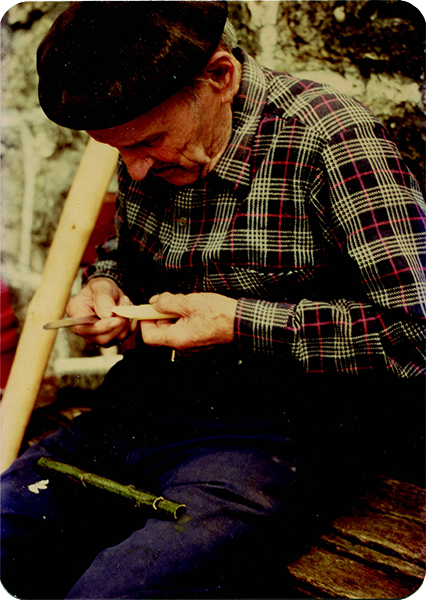
Zelestino Artola from the Eraso-Txiki farm, making a txulubita with a chestnut stick. Errazkin (Navarre), 9 May 1981. (Photo: JMBA)

Txulubitas and tutubis [trumpets] made by Zelestino Artola from chestnut sticks. Errazkin (Navarre), 09/05/1981. (Photo: JMBA)
REFERENCES
1 Translation : Txulubite malabite trumpet / Enter in France, leave in Spain / Txulubite malabite / Enter in France, leave in Spain / Sweat, sweat, sweat, sweat. ///Txulubite round trumpet / Enter in France, leave in Spain / Txulubite round / Enter in France, leave in Spain / Sweat, sweat, sweat.
